
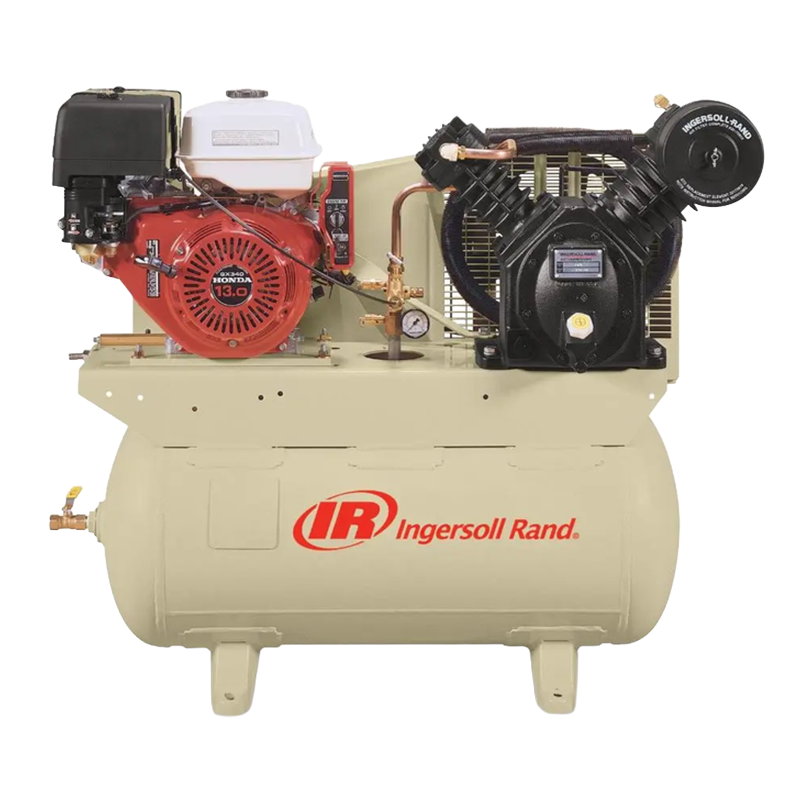
Ingersoll Rand manufactures reciprocating compressors that pressurize air day in and day out—robustly built, with high output, and designed to last for years.
A piston compressor—also known as a reciprocating compressor—compresses air using a piston that moves up and down inside a cylinder, following the same principle as an internal combustion engine but in reverse. Whereas an engine uses expansion to generate motion, a compressor uses motion to compress air. It is one of the oldest and most tried-and-true methods of producing compressed air, and remains the top choice when high pressure and a long service life are more important than absolute silence.
The Compression Stroke in Four Steps
Ingersoll Rand offers a wide range of oil-lubricated reciprocating compressors, from compact units for the workshop to heavy-duty industrial models. The oil-lubricated design ensures a long service life for the piston, cylinder, and valves, making these models suitable for continuous and heavy-duty use.
The workshop model is single-stage and designed for garages and minor maintenance. The Type 30 series is two-stage and has been the industry standard for decades: a design familiar to generations of mechanics that continues to be refined with more modern motors, controls, and energy-efficient components. The high-pressure version is multi-stage and designed for the energy, offshore, and process industries, where high final pressure is required.
Piston compressors are known for their long service life, provided they receive timely maintenance. Changing the oil, checking the valves, and replacing the compressed air filters are the most important tasks. Because the design is mechanically simple, most maintenance tasks can be handled by an in-house technical service department, which keeps operating costs low over the compressor’s service life.
Find out how JustAir can add value to your business. Call us or send us an email for a no-obligation demonstration and analysis of your needs.